

“28 YEARS LATER: THE BONE TEMPLE” Movie Review — The Number of the Beast
For those of you who want to be brought up to speed, I’ve already illustrated my thoughts on my kinda-spoiler-free review of “28 Years Later” itself. In short, there are certainly artistic and poetic attributes to apply to “28 Years Later” on a character level, the acting is unbelievably fantastic, the scope and cinematography is flawless and has one the greatest shots I have ever seen in a zombie movie, and Danny Boyle’s fashionable directing style is still prominent and works in plenty of instances in the movie. That being said, despite enjoying it to a degree, it has to be made upfront that “28 Years Later” was one of the biggest disappointments that I’ve ever seen. Not in an inflammatory sense, but in a way that you wish something so square-pegged in the hole of being okay was something that could’ve been something much more; an infectious, dreary and glorious masterpiece.
Apart from the awesome opening first act, the other two acts are littered with contrivances and other plotting issues, world-building that leaves you with more unanswered questions than a trigonometry text book, and that cliffhanger ending…that was a choice. I mean, in a post-apocalyptic coming-of-age where Spike is traversing through the wasteland trying to help his mother from a debilitating illness, ending the film off with a band of Jimmy Savilles in colored tracksuits slaughtering a bunch of ragers to “rescue” Spike wasn’t at the top of my list. It was about as much of a tonal whiplash as you can end a generally serious zombie film. Now, we have at last arrived at the sequel that is getting released six months after the original being “28 Years Later: The Bone Temple” which takes place immediately after the bizarre-as-hell ending of “28 Years Later”.
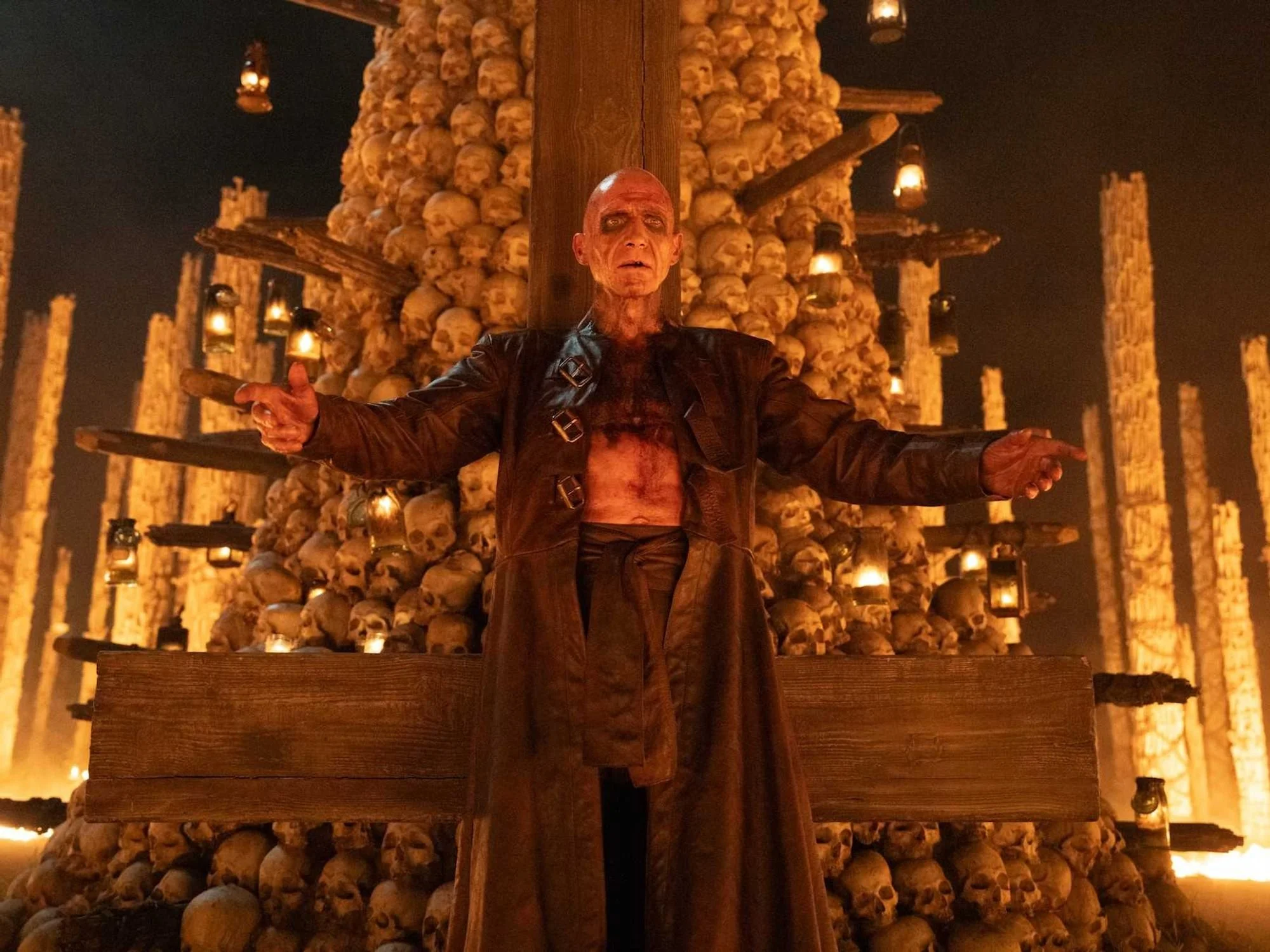
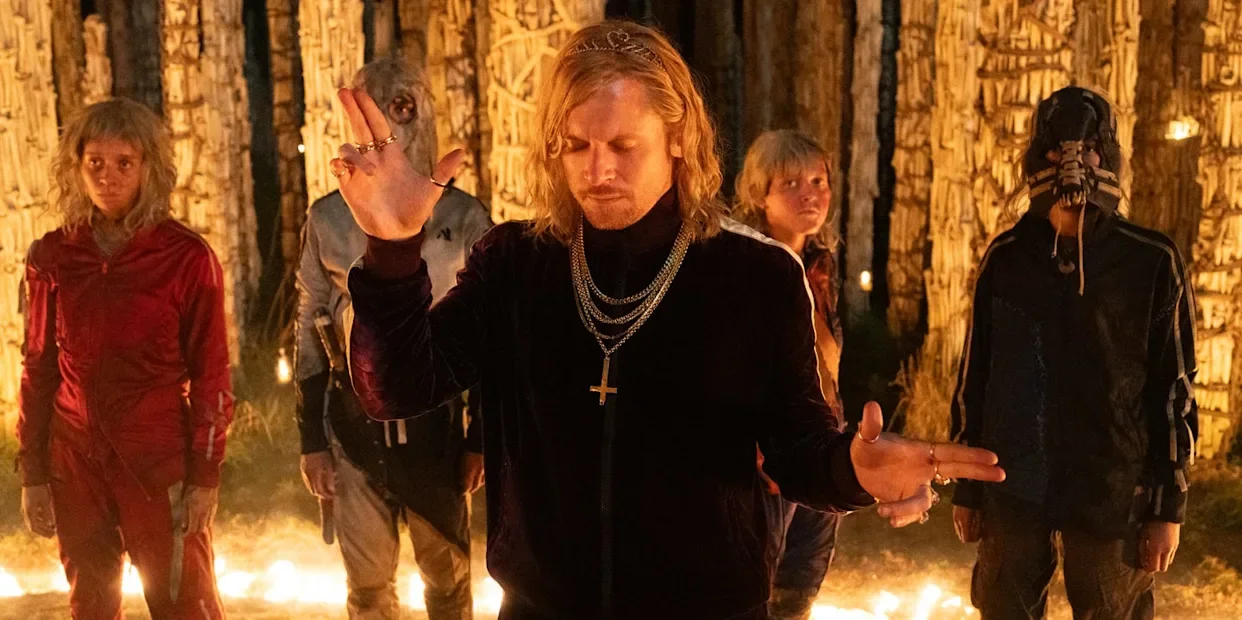
Spike must take it upon himself to escape while in the grasps of a sadistic cult led by Jack O’Connell as the extravagant, luciferian cult leader Jimmy Crystal and his followers. Meanwhile, Ralph Fiennes, playing the mysterious Dr. Ian Kelson, comes across a revolutionary discovery while using his alpha rager test subject he names Samson that could change the world and the rage virus forever. And that’s it. That’s the plot of the movie in its simplest form, no other extended details required. That is what this movie is about and that is what you get for an hour and fifty minutes. But, is it a good movie? Well, it’s complicated. That’s just another way of saying no, but bear with me, there is some good stuff to be found in “The Bone Temple”.
For Exhibit A, your honor, I will divulge into the performances and characterizations of two of the biggest spotlight hoggers of the film. First off, it is undeniable that Ralph Fiennes has established himself in project after project that he is an extraordinary, Shakespearean actor; one of the best our generation. He’s an actor who is capable of honing in any material whether it’s euphoric, grounded and sophisticated, or substandard and barren, and his performance is able to transform the character into something memorable. In the case of Dr. Kelson, Fiennes’s performance is remarkable and brilliant, displaying the portrayal of a man fascinated by the behaviors and anatomy of the ragers themselves while in the pursuit of finding an astonishing cure to, hopefully, save humanity.
One of the strongest attributes to Fiennes’s character is his doctor-test subject relationship with an alpha from the previous movie who he calls in this film, Samson. The film does a great job at not only highlighting Kelson’s ambitions of achieving an unearthly achievement for the world and establishing a true connection to something he considers his only friend in the post-apocalypse (despite being a mindless subject), but surprisingly, the movie does much more with Samson. In the first movie, if you remember when Kelson tranquilizes Samson with morphine, it basically shuts down the alpha for about 12 hours. Here, we see that he grows a lot more obsessive with morphine and is intentionally wanting to be sedated by the doctor, and the way the script does with Samson’s development over the course of the movie is something very interesting.
The second and final individual to exemplify is the one and only Jack O’Connell as Sir Lord Jimmy Crystal. This is about the second time in a row that Jack O’Connell has aced his performances for cult leader characters, first in “Sinners” and now in “The Bone Temple.” With what he brings to the table as Jimmy Crystal, we are introduced to the man who was the only survivor of his family’s home and church being swarmed by the infected. Rather than making him into a generic madman with an obsession to worshipping the dark lord, the movie gives you an insight as to what kind of individual he is and why he has chosen this path of being this satanic cult leader (yes, Jimmy Crystal is a satanist). O’Connell is able to juggle both the damaged and psychotic persona of Jimmy Crystal to a T and every time his character is on screen, he invokes a sense of menace to the audience.
‘But hold on,’ I hear you interject from your computer screen, ‘what about the main character of this 28 Years Later trilogy, Spike?’ Well, on the upside, where Alfie Williams is magnanimous much like his previous performance, on the downside, he’s given less focus in the screenplay and the movie doesn’t give him anything to work with outside of looking scared, quivering in fear, and being afraid of what Jimmy Crystal could do to him. What’s disappointing is that he doesn’t have much development with the villain, no conversation about where they’ve come from and how’d they get here.
But I will say this about “The Bone Temple” it takes advantage of its R-Rating and…it is gory and blood-spilling like you wouldn’t believe. How gnarly the violence is aided by practical effects that make you wince and cringe due to their effective realism, whether it’s every instance a character bleeding out from a stabbed artery in their leg or in an incredibly graphic scene when a couple of characters are flayed alive. If you don’t know what flaying is…it’s like peeling a banana, except the banana is…yeah.
But for how sick the bloody mayhem is in this film, there’s a crap ton of plot armor. For example, you know how in Game of Thrones: Season 8, where a character would be cornered and swarmed by zombies giving you the suspicion that the character is going to die only to cut away and the next thing you know they’re totally fine. I swear to you, it happens in this movie. A character is being attacked on all sides by the infected and surely you’d believe the character would be eaten for lunch right? Nope. He gets like a few bite marks on him, but other than that he’s good. Then again, if that one other character were to die to the infected masses, then that character’s entire development and contribution to the plot would’ve been totally pointless.
Previous installments have introduced some nifty and some outlandish evolutionary mechanics for the ragers. In 28 Weeks Later, you had carriers, survivors immune to the virus but still capable of spreading it, and in “28 Years Later”, you have fat, slow moving zombies, large towering alphas commanding their hordes, and female ragers capable of giving birth to uninfected babies (still don’t know how that works, and I don’t know if this franchise ever will tell me how). Now we have another mechanic to add to the ragers and, I’m not sure how I feel about this. The ragers have this thing in their heads that is similar to psychosis as Kelson put it, where the ragers see other survivors as monstrous ragers themselves and this is also what drives them to kill and even eat them. Just one question: if that is the case, if every rager sees another survivor as a ravenous rager like themselves, wouldn’t they just kill each other? What makes it much more of a waste world-building thread, is that we don’t see how the ragers view each other, do they see each other as innocent savages? You know what, I don’t think the director and writer thought this through. It’s something that the film shows in the beginning and proceeds to do nothing with it.
Speaking of ragers, plenty of people have already and I guess I’m late to the party on this, but it has to be specified. Here in this post-post-apocalypse where the United Kingdom has been ravaged by ragers who over the course of 28 years have evolved into flesh-eating savages, and their blood is so contaminated with the rage virus that a blood drop that would fit on a pinhead could infect a human within seconds if it gets in their mouth, eyes or nose, and at no point does any survivor or in this ruined, desolate, rager-populated country arrive to the conclusion of—oh, I don’t know—wearing a mask to protect themselves. I mean, we have many instances in this film in which a character is fighting off a rager and the rager’s blood gets into a character’s face and it turns them into one of the infected. Hell, this was even an issue in the prior installment, especially with the Saville gang brutalizing the infected with no safety precautions when engaging in close quarters. I guess they’re just that confident. Not only does it make every single survivor that exists and or gets killed a blithering imbecile, but it erases the stakes and lowers the danger of how threatening the rager hordes can be. All you have to do is sidestep, strike, drop and roll and you’re good.
And just when you think that you have seen everything that the movie throws at you from its gut-spilling violence that doesn’t flinch for a second, and the top-notch performance powerhouses of Jack O’Connell and Ralph Fiennes and their characterizations, you arrive at what could be described as a radical, metalliferous climax so aesthetically and visually staggering in a way that is strangely alluring that it makes you practically ignore that plenty of what happens makes no sense.
“28 Years Later: The Bone Temple” is messy on numerous occasions, but I wouldn’t be remiss to say that I didn’t have a solid time watching it. Fiennes and O’Connell carry the movie on their shoulders, it’s visually interesting and it has some things going for it, but is it a sequel that is going to hype me for the next installment? Probably not. Although, I’ll watch it out of obligation to see where this story will go.
Moral of this review: Don’t be a satanist.
RATING: 2.5/5
