

“ANIMAL FARM” (2026) Movie Review — An Absolute Pig Sty
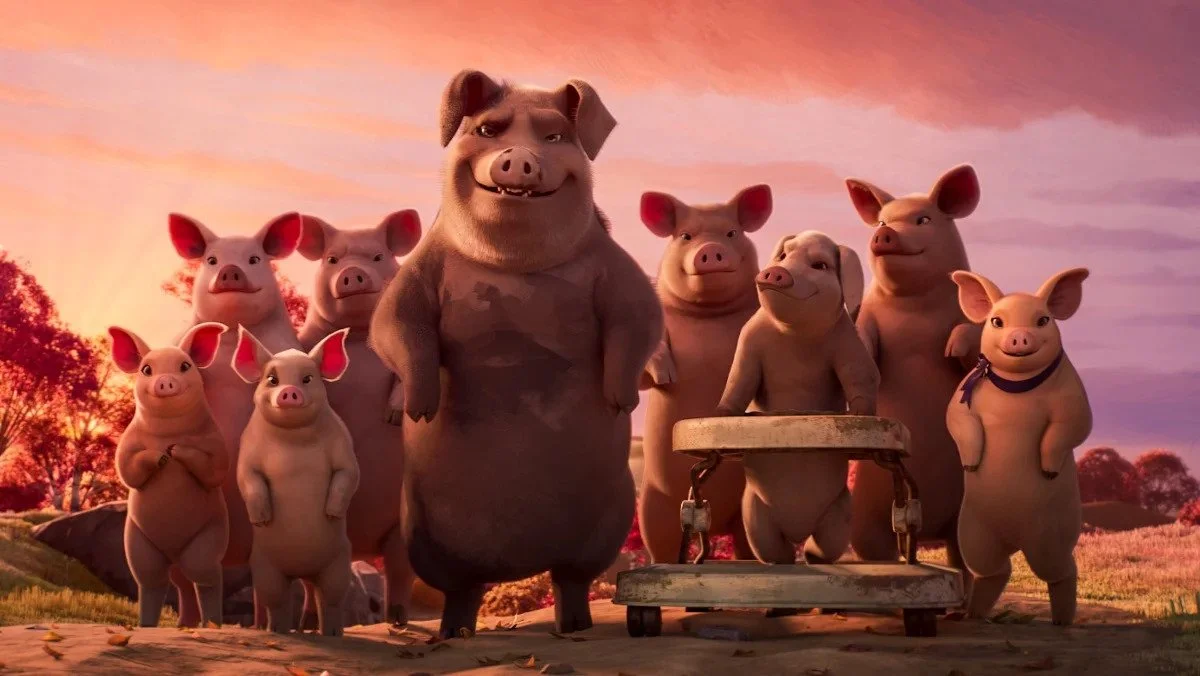
Before publishing the dystopian classic and cautionary tale, “1984,” a book inspired by the godfather of the dystopian genre, Yevgeny Zamyatin’s “WE” published with an English translation in 1924, social critic and acclaimed author George Orwell wrote one of the most ingenious pieces of literary satire in the 20th century, ‘Animal Farm’. Animal Farm, as many have described it, was a satirical exploration into the Russian Revolution led by Vladmir Ilyich Ulyanov (better known as Lenin) and the Bolsheviks taking over Russia once controlled by the Tsar of Russia, Nicholas II, before being executed by the Bolsheviks, leading up to the brutal, totalitarian reign of Joseph Stalin. It is an insightful book critiquing the worst economic system ever conceived by man, which is socialism (ironic given Orwell himself was a socialist), and ideas of human behavior when given absolute power through the perspective of farm animals. Many of them represent historical figures, i.e. Old Major as Karl Marx, Snowball as Leon Trotsky, Napoleon as Stalin, and being metaphors for certain groups like Boxer the Horse being an allegory for the working class, the Sheep being the subservient masses persuaded by the propaganda machine portrayed by Squealer; you get the idea.
It’s a timeless story to this day, so much so that in 1954, there was an animated film that was funded by the Office of Policy Coordination, a branch of the CIA meant to be anti-communist propaganda. Though it was a financial failure, it’s still being taught in schools to this very day and its commentary on totalitarianism and socialism remains impeccable.
72 years later, we have a new adaptation of Animal Farm (2026), distributed by Angel Studios, the same production company behind “Sound of Freedom,” “Solo Mio” with Kevin James and “David,” a very solid animated film about one of my favorite Bible stories. I find it astonishing that this movie came from the same company behind those films, because watching what has been wrought on the silver screen felt like cinematic equivalent of experiencing the Russian gulags. Yeah, this was just miserable and uncomfortable to sit through. But really, who’s surprised by this?
A fact that you guys also have to keep in mind: this movie has been in development since 2011. Going through the hands of different directors from Rupert Wyatt to Andy Serkis himself, different production companies, being distributed by Netflix before eventually dropping it, originally going to be a film performed entirely in motion-capture until it then became just a straight-up animated film. The whole production was just a nightmare, but what makes the film worse is that rather than just making a movie about the Russian Revolution, the dangers of socialism and Stalin’s dictatorship, they just took the easy route and made it into an anti-capitalist film.
Yeah, the plot of this movie is the same but told much more differently, and not for the good. Before being sent away to the Slaughterhouse because Farmer Jones couldn’t pay the bank and a corporation named Pilkington Industries, led by Freida Pilkington, wants the land for their own money-making purposes, Snowball (played by a miscast Laverne Cox) leads a successful rebellion against the humans. With the farm to themselves, they established themselves a haven with a set of rules promising equality among animals. The problem is that they have no earthly clue how to manage a farm themselves.
But once Snowball has an idea of a water mill to build for electricity for machinery, warmth and to store half of the food for winter (which wouldn’t make sense because the food like watermelon, apples, corn, etc., would spoil in a matter of weeks), Napoleon embarrasses and kicks Snowball out on the basis that his ideas are boring and stupid. Our main character, a small piglet named Lucky (who’s not anywhere mentioned in the book) is torn as to whether or not to listen to the ideologies between Snowball and Napoleon (played by Seth Rogen…yes, you read it correctly), while being the basic wide-eyed innocent child and taking in the exciting new prospects with Napoleon’s leadership. But once Freida Pilkington enters the picture and manipulates Napoleon for all of the money he could make to live the capitalist dream, our protagonist realizes that maybe other farm animals weren’t so equal after all.
It would be one thing if this was a different animated film that pokes fun at capitalism. The problem is that it bears the name ‘Animal Farm’, and the changes that are implemented into this new adaptation strip what made Orwell’s book enriched with depth and meaning in order to pander to a modern audience. What director Andy Serkis has done is basically take the entire context from the original source about the Russian Revolution and the true horrors of communism and socialism, and reverted it to be about capitalism and over-consumption.
What Orwell articulated in his book is that with the pigs being the more intelligent group of animals, they allowed themselves to exploit the lie of equality, virtue signal and manipulate the truth to the less-intelligent animals in order to satisfy their needs and get what they want. For example, Squealer would manipulate the animals into thinking that the only reason that they need to eat apples (even though some don’t even like them) is out of necessity to stay in power. Sure, the other farm animals thought they were getting apples and milk shared equally, but the pigs needed them the most for their brains in order to develop to run everything, otherwise the animals would suffer. In the movie, it reduces all of the nuance and instead states that the Pigs became corrupt because of consumerism and that Pilkington influences Napoleon to become as money-hungry as she is.
The villain, Freida Pilkington, her motivation is that she wants the land that the farm inhabits, because she wants money, not because she’s desperate to grow back success into her company. It’s every shallow anti-capitalist motivation that has been tried in memoriam. At the same time, there’s literally no point to wanting to own the land because she’s already built a multi-billion dollar infrastructure.
A final note when criticizing the story is that in this 90-minute monstrosity, it reaches an ending similar to the book where our main piglet realizes that the pigs have become so megalomaniacal that he can’t distinguish between man and pig. But does the movie end there? Nope, it gets worse. The animals decide in an attempt to stop Napoleon once and for all from having another revolution, and how they go about executing their plan makes absolutely no sense and would end up endangering the lives of man and the animals. This is until it culminates into a half-assed ending about the animals realizing that the true lesson they learned is that helping others is the true freedom, not because they have to, but because they want to.
The voice acting from the cast ranges from great, solid performers who deserve better from the material provided (Woody Harrelson as Boxer, Iman Vellani playing the twin girl piglets Puff and Tammy—one of whom becomes Lucky’s love interest, Steve Buscemi and Pilkington’s right hand man, Mr. Whymper), to horrifically miscast and obnoxious (Laverne Cox as Snowball, and the tiresome presence of Seth Rogan as Napoleon).
Every joke in this movie feels like the adults were trying to appeal to the next generation, but their attempts of humor feels so dated you can feel the kids in the theater age. From juvenile fart jokes, to lame pop culture references, to hijinks and pratfalls of characters running into each other, all of which compromises and interferes with the nuance and complexity of Orwell’s work. On a technical level, do you remember how “Norm of the North” (yeah, remember that movie?) had a habit of cross-dissolve transitions after every scene? Well, “Animal Farm (2026)” has a habit of fade-to-black transitions, and how most of them are utilized is utterly bizarre and rampant: after a dramatic moment, after a punchline, and especially after the climax. So much so that it affects the editing and pacing as a whole.
At least “The Super Mario Galaxy Movie” was great animation despite the rest of the movie being the equivalent of getting diabetes, the animation is uninspired and stale at best and hideous at worst. The animal designs are generic, some of which try to be 3D versions of the 1954 animated version, while the human designs, buildings, environments, and farms are on the verge of resembling something from a poorly made straight-to-DVD animated sequel.
It’s about as shameful of an adaptation as Illumination’s “The Lorax.” Corporate, disingenuous, and mean-spirited all the way through, Andy Serkis’ “Animal Farm (2026)” just goes to show you that some animated movies are more equal than others.
RATING: 0/5
